
TUZHE PACKAGING GUIDE
Pizza Box Materials: Paper Surface and Board Structure
Compare pizza-box paper surfaces separately from board construction. Understand why kraft, white and corrugated are not three mutually exclusive material choices.
On this page
A pizza-box description may say kraft, white, printed or corrugated. Those words do not all describe the same feature. Before comparing samples or quotations, separate the paper surface from the board construction and the finished artwork.
Read the description in layers
Kraft and white can describe the visible paper face. Corrugated describes a construction with a fluted layer. A corrugated box can therefore have a kraft or white outer surface, and either surface may carry printed artwork. “Printed” is not a separate structural material.
Ask for the full proposed board description and, where helpful, a cross-section or sample edge. Record the inner surface and any separately supplied liner as well as the exterior. A photograph of the lid cannot provide that complete specification.
| Specification layer | What to identify |
|---|---|
| Outer face | Selected paper surface and appearance reference |
| Board build | Stated layers and construction, including flute where applicable |
| Food-side arrangement | Inside surface and any separate liner |
| Printed design | Artwork revision, panels, colors and finish |
Keep size equivalent when comparing constructions
Use the same pizza size and comparable usable internal space. Two cartons with the same nominal inch description can have different clearances or corner shapes. If the contents sit differently, note that before attributing the outcome to the board.
Review base support, lid position and locks with the intended serving and liner. Include the normal packing and handoff routine. A thicker-looking sample should not automatically be described as better; the relevant question is whether the stated construction meets the agreed application.
Review the artwork on the chosen surface
The outer paper contributes to the final appearance. Assess important colors and small text using an agreed proof for the specified surface. Confirm artwork on the final dieline so that fold lines, locking tabs and the lid opening do not interrupt information that needs to remain visible.
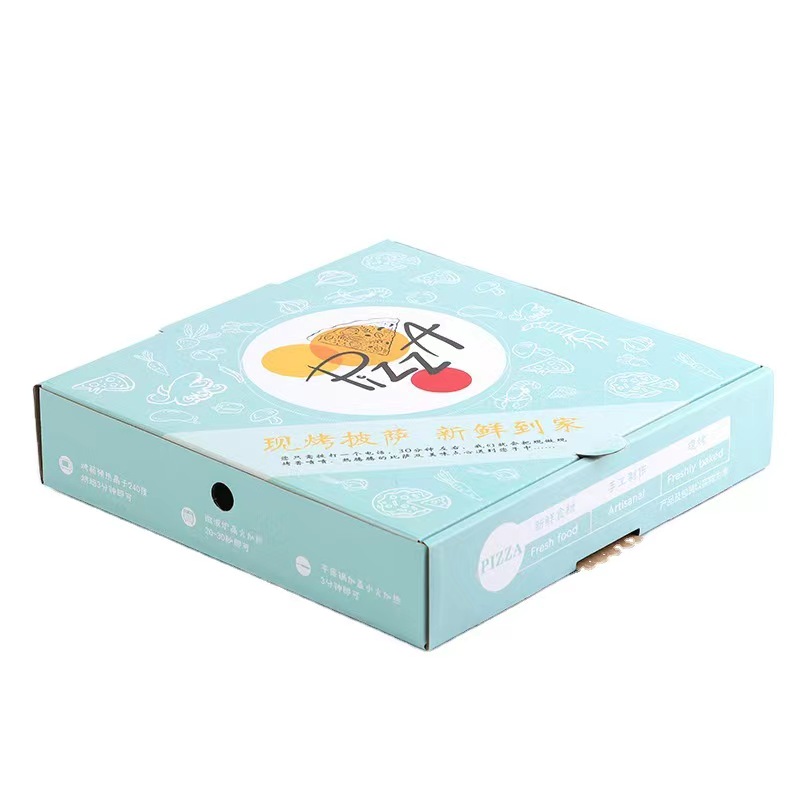
Compare plain brown kraft pizza boxes and white boxes with illustrated lids as surface and presentation references. Full-color corrugated pizza boxes show how graphics and a structural description can coexist. The precise supplied board remains a separate specification.
Use a filled service trial to identify questions
Observe the package under the intended packing and holding routine, recording any marking, lid distortion, base movement or difficult closing step. Describe what happened and where. Do not convert an informal observation into an unsupported food-contact, temperature or strength claim.
If the food or service conditions change, ask whether the selected material and liner arrangement remain appropriate. The same artwork can appear on constructions that should not be assumed equivalent.
Put all four layers into the request
A useful quotation request combines internal size, complete board description, inner arrangement and artwork status. This lets a supplier explain substitutions and makes competing responses easier to compare. Use a structured packaging brief and retain those references through sample approval.