
TUZHE PACKAGING GUIDE
Plan a Paper Bag Range for a Bakery Counter
Build a practical bakery bag range around boxed cakes, bread and takeaway orders. Compare shared sizes, packing tasks and exceptions before standardizing the artwork.
On this page
A bakery rarely needs a different bag for every item, but choosing one bag for the entire counter can create a different problem: staff must improvise whenever an order does not fit. Plan the range around recurring packing tasks, then decide where one format can reasonably serve several products.
Map the orders customers actually carry
List common purchases as complete orders. A single loaf, two pastry cartons and a boxed birthday cake are three different arrangements. Record whether the food is already enclosed, how many items travel together and whether the customer needs a handle.
Use the finished inner packs for measurement. Their lids, side tabs and handles can extend beyond the food itself. For a carrier, the opened base and the loaded arrangement matter more than how much empty space appears near the top.
| Counter task | Starting format | Question before sharing a size |
|---|---|---|
| Carry a closed cake carton | Wide-base paper carrier | Can the largest carton enter and remain level? |
| Enclose a loaf | Bag with a suitable opening and closure | Do the shortest and longest loaves both present well? |
| Hand over one ready-to-eat snack | Food sleeve or small food bag | Can the portion be loaded and eaten as intended? |
| Group several takeaway containers | Outer carrier sized to the arrangement | Do the containers remain supported without crushing one another? |
Choose a normal case and an exception
For each proposed shared size, trial an everyday purchase and the largest arrangement it is meant to accept. The small order reveals excess movement or an awkward presentation; the large order reveals a tight opening, shallow base or insufficient height.
Do not make a rare oversized order the reason every customer receives a large bag. An identified exception format may be more practical. Equally, two nearly identical bags can confuse staff if their difference is hard to recognize when stored flat. Mark sizes clearly at the packing station.
Test the range at the counter
Ask staff to open the selected bag, load the complete purchase and pass it across the counter using the intended grip. Record which order was used and where hesitation occurs. A base that technically fits the carton may still be awkward if the opening repeatedly catches its corners.
Use bag dimensions and gusset measurements to resolve a geometry issue. If the problem is the function of the pack itself, return to the carrier, window bag and sleeve comparison rather than simply increasing every dimension.
Apply a common identity after the range works
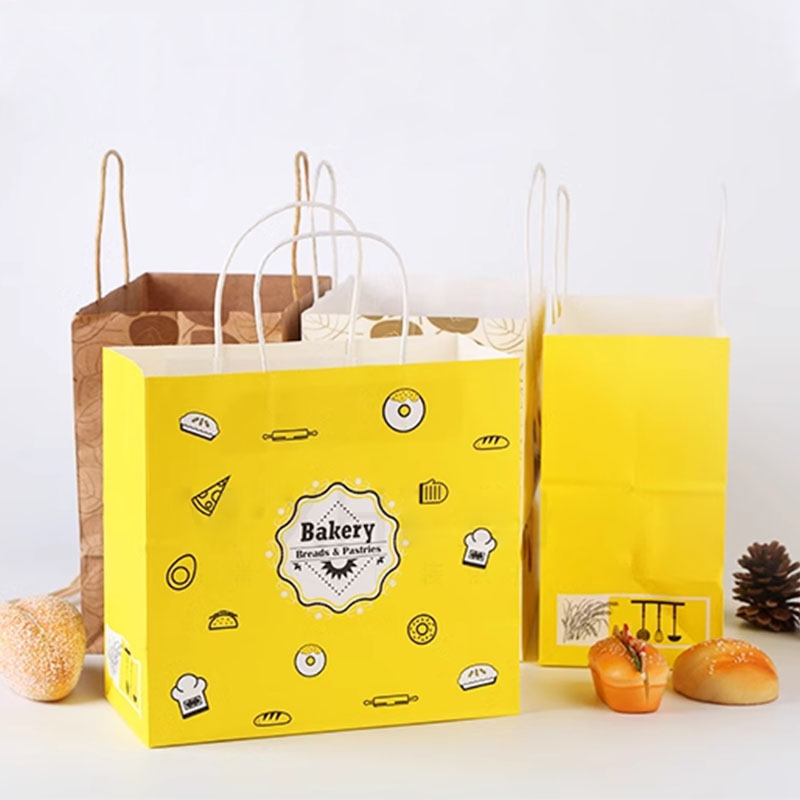
Coordinates such as logo position, paper appearance and label style can make a small range feel consistent without forcing identical structures. Compare printed bakery carriers and window bags for bread as different roles within the same counter presentation.
Keep a one-page reference showing which purchase uses each bag. Include the permitted combination of inner packs and the exceptional orders that need another format. That record is the practical output of range planning; it is more useful to staff than an artwork sheet alone.