
TUZHE PACKAGING GUIDE
Fit Burger Boxes to the Finished Menu Item
Choose burger packaging using the assembled menu item, liner and extras. Check height, hinge access, front locks and order labels through the real packing sequence.
On this page
The size of an empty bun is not the size of a finished burger. Fillings, sauce, a liner and optional extras can change both height and handling. Select the carton around the menu configuration that staff actually pack.
List the variations the carton must serve
Identify the standard burger, the tallest normal variation and any item with a wider or less regular footprint. Include extras that are sold within the same box. A shared carton can work across a range, but its fit needs to be checked against that defined range.
Measure the assembled serving without pressing it down to obtain a convenient number. Record width, depth and height with the intended liner in position. A photograph helps explain the shape and ingredient arrangement but should accompany the measurements.
Watch the lid travel
A hinged lid moves through an arc as it closes. Observe its inside edge and the position of the highest part of the burger. Check the closed space and the closing movement: a bun can be disturbed before the lid reaches its final position.
Confirm that the front lock engages without compressing the serving or pulling the liner into the tab. Where staff repeatedly have to reposition the food, identify whether the problem is the carton dimensions, the liner placement or the packing sequence.
Keep food conditions and fit observations distinct
Describe the sauce, oil or moisture exposure and the actual packing routine when asking for the proposed board and liner specification. In a representative trial, record visible marking and changes to handling separately from a lid clash.
A successful fit does not establish every material property, and a grease-related description does not guarantee fit. Keep the supplier’s construction information alongside the physical observations for the selected sample.
Make the right order visible in a stack
Place the menu or size label where staff can read it during handoff. Inspect the carton in the stack or outer bag used at the counter. A clear label on the top face may become hidden when another box sits above it.
If two sizes look similar when flat, use a simple identification method at the packing station. Review it with staff using the boxes rather than relying on a color distinction that is subtle under service lighting.
Compare actual carton references
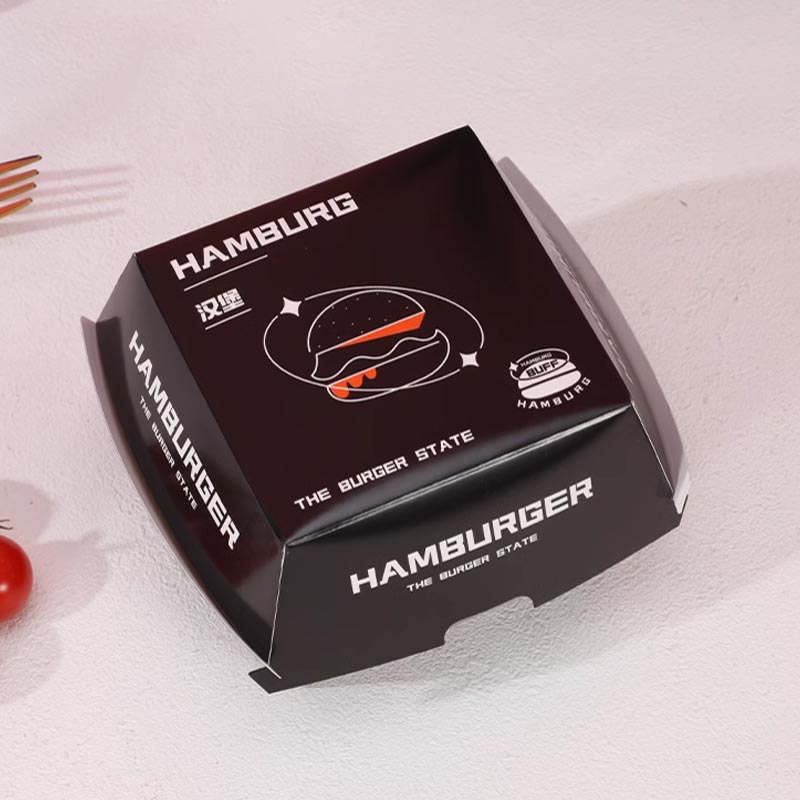
Printed burger boxes with folding closures and white printed hamburger clamshells provide different presentation references. Match the complete sample to your portion and closing routine before choosing artwork or a shared menu size.
For meals sold with fries, check the combination using the fry-pack serving guide. A burger box and a fry tray that work separately may need a different outer arrangement when packed together.
Write the selection rule for staff
Record which menu variations use the chosen carton, the liner position and the final closure check. Identify any oversized configuration that needs another format. This gives the packaging decision a useful boundary and prevents later menu changes from silently exceeding the reviewed fit.